


| Latest version | 2.24.0 |
|---|---|
| Minimum Core | 13 |
| Compatible Core | 14.364 |
| Last updated | 3 days ago |
| Created | 1 month ago |
| Authors | |
| Languages |
|
| Systems | All systems |
| Project source | Project URL |
| Report bugs | Bug tracker URL |
| License | License URL |
Your AI co-pilot for Foundry VTT
You bought Foundry to run the game for everyone else. Familiar takes the dungeon master's side: the rules, the dice, the monsters, every NPC in its own voice. So you finally get to play. Solo, one on one, or a full group.
207 tools across 25 domains. 28 AI providers. Bring your own key. Not a replacement DM, a co-pilot: you stay in the story, Familiar runs the table, and the dice and the math are always right.
Two weeks free, then $5 a month. Details under Pricing below.
Plays at any table
However many show up, you get to play. The fewer humans at the table, the more of the world Familiar runs, the dice, the monsters, every NPC, and on D&D 5e the rules. You take a seat at the game you usually run for everyone else.
| Your table | What Familiar runs for you |
|---|---|
| Solo (just you) | You play your character. Familiar runs everything around it: every NPC in its own voice, every monster's turn, the scene, with 2024 D&D 5e rules enforced. Campaign memory carries the world from one session to the next. |
| Duet (you and one other) | Neither of you has to be the DM. Familiar runs a D&D 5e (2024) world for both of you, the cast, the encounters, the rulings, so you stay players and the story still moves. |
| Small table (you and a few) | The supporting cast and the monsters' turns run for you, with the lighting, the music, and the rulings, so nobody steps out of the game to keep it moving. |
| Full group (you DM for four or more) | The tactical load comes off the GM. You run the encounter and tell the story; Familiar handles initiative, the monster turns, and the bookkeeping. You run the scene, not the spreadsheet. |
It runs the DM's side around you; it never invents the story. Whoever is at the table, the campaign you brought is the spine, and the dice and the math are always right on D&D 5e (2024). No "you rolled a 47."
Say it, and it happens
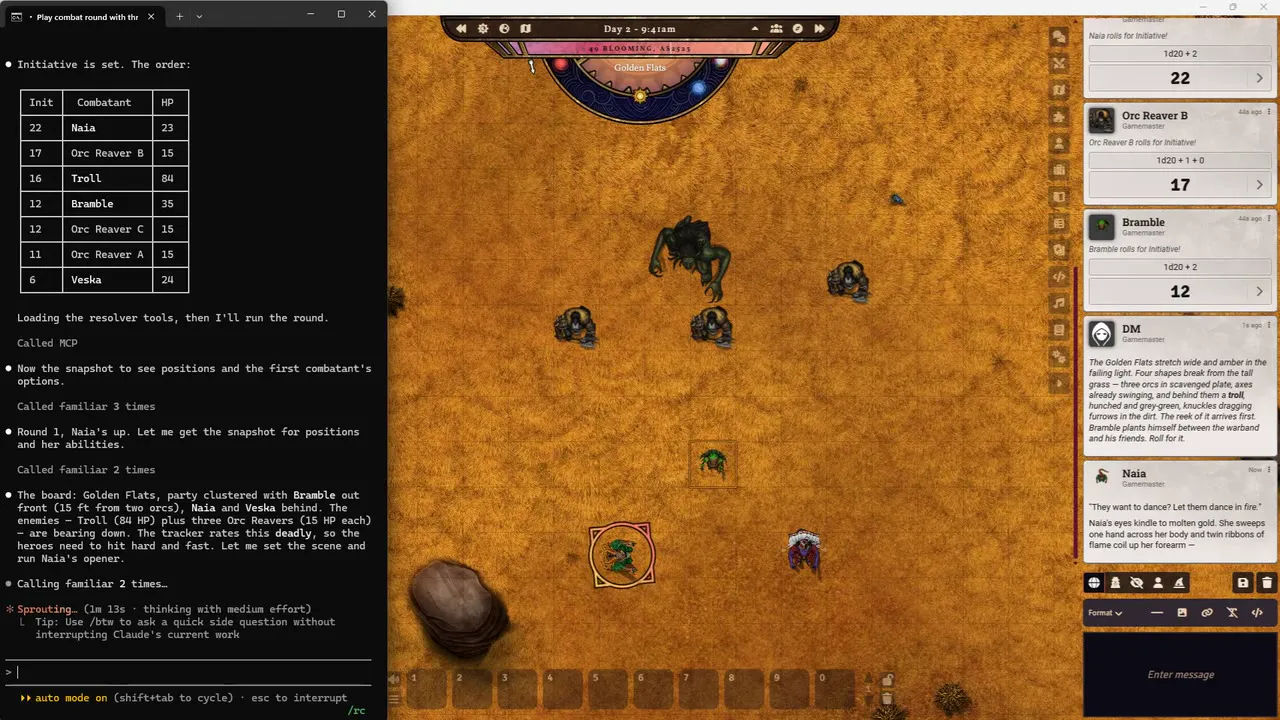
Type "the goblins ambush the party from the treeline" and Familiar rolls initiative, drops the goblin tokens into cover, dims the lights, cues the forest ambience, and gives each goblin its own voice. One sentence, half a dozen domains, no sidebar-hopping.
Most AI tools narrate combat. Familiar referees it.
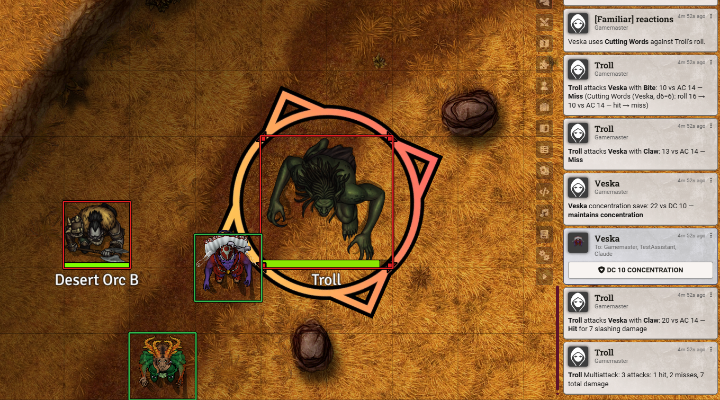
A rules engine sits between the AI and your game. Every attack, spell, and move is checked against the D&D 5e (2024) rules before it lands. Out of range, out of turn, no slot left, action already spent: the move comes back refused with the reason, the AI adapts, and Foundry's own dice roll every result.
What runs today
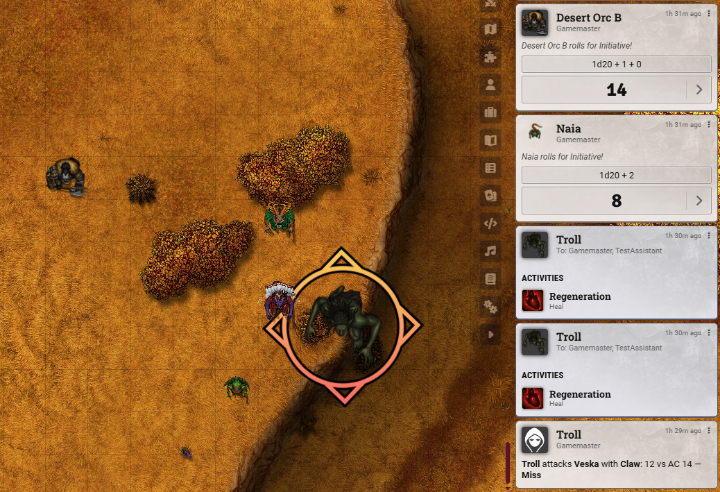
- The full turn loop: initiative, movement checked against speed and walls, multiattack, legendary actions
- Fourteen reactions that fire themselves: opportunity attacks, Shield, Counterspell, Legendary Resistance, Uncanny Dodge, Cutting Words, and Sentinel among them
- Weapon Mastery riders on the hit, grapple and shove as the 2024 saving throw, concentration checks at the real DC
- Persistent zones like Spirit Guardians, summons that join initiative, Polymorph as a real transformation
- Death saves, massive-damage instant death, and an undo that survives a reload
It runs standalone: no MidiQOL, DAE, or premade-effects stack required. The automation layer is built in, written for an AI driver from the first line. The referee is also optional: one world setting turns rule enforcement off for the whole table, for when MidiQOL already runs your automation or your table rules differently. And where a rule is not modelled yet, Familiar flags it and leaves the ruling to you. It never guesses.
Auto-Pilot. Click Run NPC Turn and walk away. Familiar takes each turn from a snapshot of the battlefield, scoring the move and reading cover before it commits. It runs the monsters and any friendly NPC in the order, never a character a player owns. Close the chat window and it keeps going, reporting each turn as a card whispered to you. Safety caps and optional turn-by-turn confirmation keep it in check.
Plays what you play
Foundry lists more than 450 game systems, and the campaign you brought runs here whichever one it was written for. Story, NPCs, scenes, lighting, audio, voices, images, transcription, and campaign memory work on any system, and Familiar reads your characters the way your system stores them. One part stays D&D 5e (2024) only: refereeing combat. On another system the tracker, the turns, and the tokens still work; the rulings stay yours. The system-by-system line is drawn at familiarvtt.com/systems.
The whole DM side of the table
- NPCs and narration: plays every NPC in character and in voice, and runs the published adventure you imported
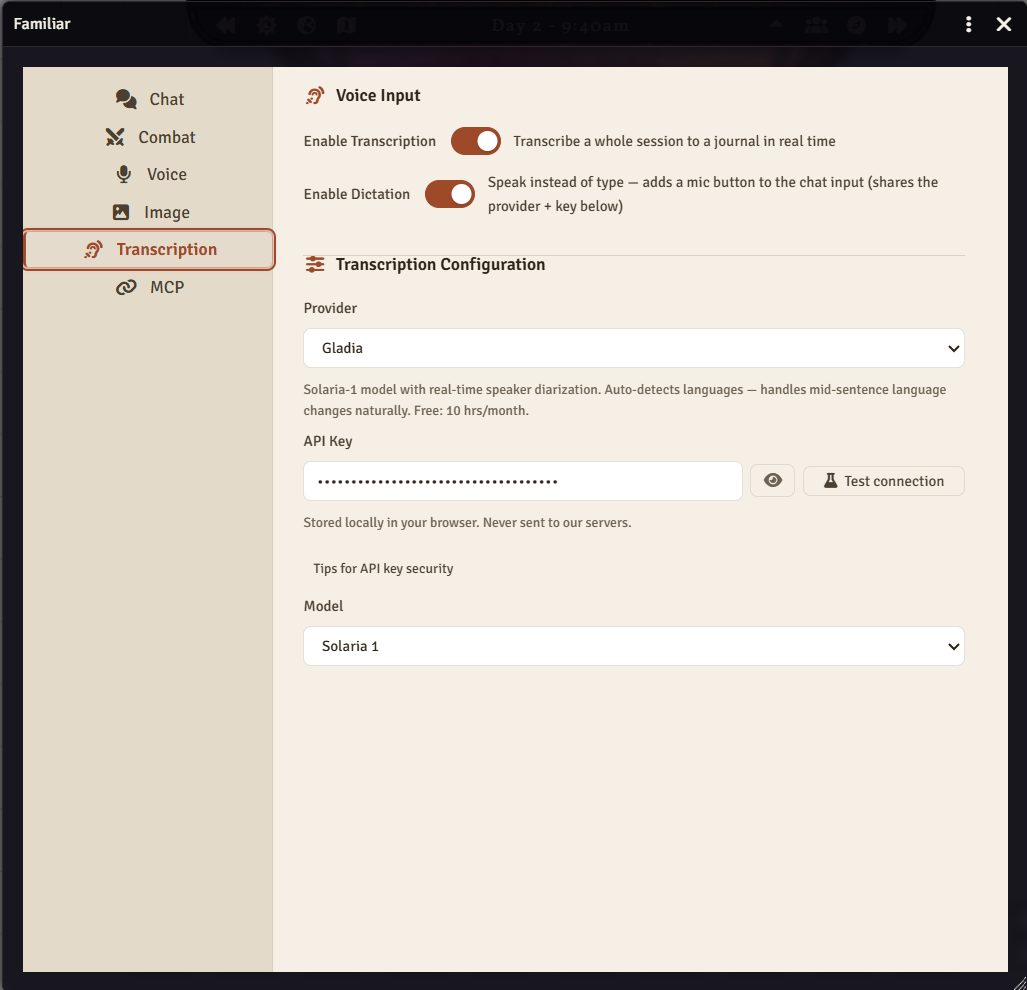
- Live transcription: speak instead of type. Real-time transcription with per-speaker colour-coding, saved to an editable, searchable Foundry journal
- Scenes and canvas: create scenes, place tokens, draw walls and doors, set lighting, darkness, and weather
- Voices and images: a distinct voice per NPC, plus character portraits, item art, and battle-map backgrounds generated inline
- Audio and atmosphere: play, stop, and crossfade playlists and tracks with volume and fade
- Knowledge and memory: full-text search across every journal, character, scene, item, and transcript, with a memory bank that carries campaign facts between sessions
- Multi-session chat: pin, archive, and switch named campaign threads, each stored as a Foundry journal entry
- Characters and items: build NPCs, manage inventory, apply effects, and clone monsters from any compendium
207 tools across 25 domains
| Domain | Tools | What it does |
|---|---|---|
| Combat & Initiative | 20 | Start encounters, roll initiative, advance turns and rounds, correct the tracker |
| Scenes & Tokens | 19 | Build scenes, place and move tokens, configure vision and movement |
| Canvas Environment | 18 | Walls, lights, weather effects, fog of war, darkness levels |
| Characters & Actors | 16 | Create, inspect, and update player characters and NPCs |
| Combat AI | 16 | Resolve attacks, spells, saves, and movement; read the battlefield; undo the last action |
| Audio & Playlists | 14 | Start, stop, and fade music and ambient sound |
| Journals & Notes | 10 | Create and edit journal entries, map pins, and handouts |
| Card Decks | 9 | Create, draw, shuffle, and reset card stacks and decks |
| Canvas Drawing | 8 | Draw shapes, text, and freehand annotations on the canvas |
| World & System | 8 | Read world info, system settings, and installed modules, advance time, pause, manage users |
| Rollable Tables | 7 | Create tables and roll on them for random encounters or loot |
| Macros | 7 | Create and edit chat macros, run the script macros you wrote |
| Compendium & Rules | 7 | Search compendium packs and rule references, create an actor from any entry, create packs and push updates to them |
| Items | 6 | Create, update, delete, and search world-level items |
| Ember Events | 6 | Quests, story events, and hex-crawl exploration via the Ember module |
| Knowledge & Memory | 6 | Search the campaign knowledge base, store and recall facts across sessions |
| Active Effects | 5 | Apply, remove, and toggle buffs, debuffs, and status effects |
| Folders | 5 | Organise documents into folder hierarchies |
| Regions | 5 | Define map regions with triggered behaviours |
| Voice Generation | 4 | Generate NPC speech audio with distinct AI voices |
| Notes Vault | 4 | Read, search, and list notes from your Obsidian vault, read-only |
| Chat Messages | 3 | Send and read chat messages, push clickable roll requests to players |
| Scene Generator | 2 | Generate AI battle-map backgrounds from a text description |
| Dice | 1 | Roll any dice expression with full Foundry roll parsing |
| Image Generation | 1 | Generate character portraits, item art, or concept art on demand |
How it works
You talk to your AI. It reaches Familiar over a secure local link, and Familiar runs the Foundry actions.
- You say it: in the built-in chat or your own MCP client
- A secure local link: GM-gated WebSocket on localhost, shared-secret auth
- Familiar runs it: tokens, dice, conditions, and audio, all in Foundry
Bring your own AI, any of 28 providers
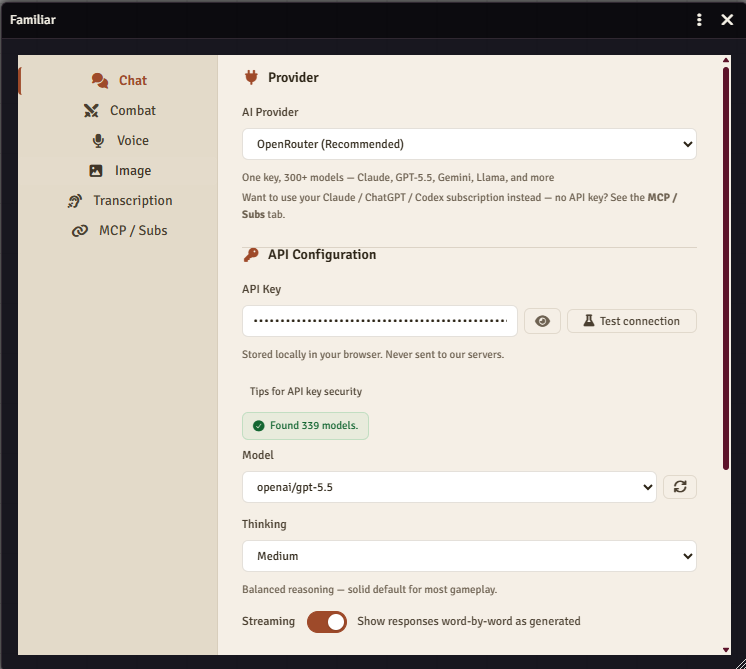
Chat (16): OpenRouter (one key, 300+ models), Anthropic, OpenAI, Google, Groq, Mistral, Together AI, DeepSeek, xAI, Cohere, Perplexity, Fireworks AI, Cerebras, SambaNova, NanoGPT, or your own local or custom server. One-click presets cover Ollama, LM Studio, llama.cpp, and LiteLLM, so the model can run on your own machine with nothing leaving your network.
NPC voices (5): ElevenLabs, Cartesia, OpenAI TTS, OpenRouter TTS, or a custom TTS server. Images (4): OpenAI (GPT Image), fal.ai, Leonardo AI, OpenRouter. Live transcription (3): Gladia, Deepgram, AssemblyAI.
Your key travels from your browser straight to the provider. Familiar never proxies, meters, marks up, or phones home.
Two ways to connect
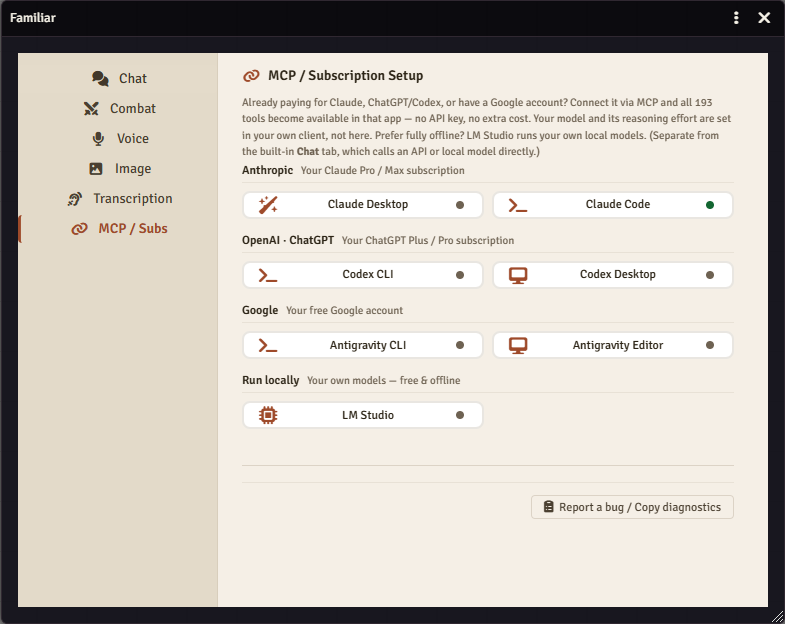
Built-in chat talks directly to any of the 16 chat providers. Nothing else to install, and live transcription, auto-pilot, and voice dictation live here. Or bring Claude, ChatGPT, or Gemini over MCP: point your own client at Familiar and the subscription you already pay for drives the game. Six work out of the box: Claude Desktop and Claude Code, Codex CLI and Codex Desktop (ChatGPT connects through Codex), and Antigravity CLI and Antigravity Editor. A setup wizard writes each client's config for you, shared secret included.
Safe by design
- All world access is GM-only
- The WebSocket bridge runs on localhost with shared-secret authentication
- Every input is sanitised against document-update tampering and prototype pollution
- The AI cannot author or run script code
- Risky actions stop for confirmation before anything lands
Pricing
Free for 14 days, then $5 a month or $45 a year, and the annual plan saves you three months. That keeps Familiar maintained; your AI provider bills you directly for the tokens you spend, or a subscription over MCP and a local model cost nothing on top. No markup, no middleman, no per-turn limits.
Familiar is not sold through Foundry's content-key system, so there is no key to redeem here. You subscribe at familiarvtt.com, get a license key by email, and paste it into the module settings. Your account, invoices, and cancellation live at familiarvtt.com/account.
Who built this
I'm Ryan, a solo developer, dad of two young kids, married to my favourite person. My wife and I play D&D one on one, just the two of us, and solo DMing is a lot to hold at once: storyteller, every NPC, the rules engine, the sound, the atmosphere. I wanted a co-pilot that handled the mechanical work so I could stay in the story. One year of full-time development later, this is what I have. Built for the DM who has more ideas than free time, and wouldn't mind playing for once.
Guides and setup live at familiarvtt.com/guides, the community answers in the Discord, and the MCP server ships on npm as familiar-vtt.
Familiar is an independent product, not affiliated with or endorsed by Wizards of the Coast. It includes material from the System Reference Document 5.2.1 ("SRD 5.2.1") by Wizards of the Coast LLC, licensed under the Creative Commons Attribution 4.0 International License.</em >